At a Glance
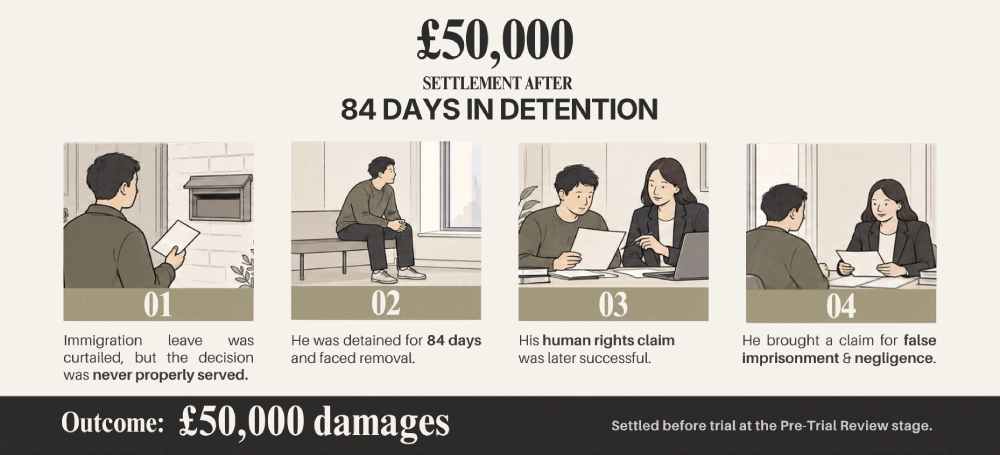
A false imprisonment claim against the Home Office settled for £50,000 after an 84-day immigration detention. The key points:
- Claim: false imprisonment and negligence against the Home Office
- Detention: 84 days, including time at Colnbrook Immigration Removal Centre
- Cause: the decision curtailing the Claimant’s immigration leave was never served on him
- Settlement: £50,000 in damages, agreed at the Pre-Trial Review stage without going to trial
- Immigration outcome: release on immigration bail, a successful human rights claim, and indefinite leave to remain granted in June 2020
Settlement of the False Imprisonment Claim
Background to the Unlawful Detention
The Claimant lawfully entered the UK in December 2016 on a spouse visa after marrying a British national. The relationship subsequently broke down in the context of domestic abuse.
In August 2017, the Claimant’s former spouse ended the marriage and required him to leave their home. She subsequently notified the Home Office that the relationship had ended. Following that notification, the Home Office decided to curtail the Claimant’s immigration leave.
However, the curtailment decision was not served on the Claimant. Consequently, he was unaware that his immigration leave had been curtailed and that the Home Office considered him liable for removal.
Immigration Detention and Article 8 Human Rights Claim
In June 2018, immigration officers detained the Claimant at his workplace as part of a planned operation. The officers informed him that he was unlawfully present in the UK and handcuffed him. He was subsequently taken to Colnbrook Immigration Removal Centre, where he remained in detention.
While detained, the Claimant was served with a notice inviting him to make further submissions. He responded by raising a human rights claim under Article 8 of the ECHR, explaining that he had experienced domestic abuse and arguing that he should be permitted to remain in the UK on that basis.
Despite the claim, the Home Office continued to pursue his removal and set removal directions for only a few days later. The Claimant subsequently instructed us to assist with securing his release from detention.
Immigration Bail, Release and Immigration Outcome
The Claimant was eventually granted immigration bail by the First-tier Tribunal and was released after spending 84 days in detention.
He later succeeded in his human rights claim before the First-tier Tribunal. In June 2020, he was granted indefinite leave to remain in the UK as a victim of domestic violence.
False Imprisonment Compensation Proceedings Against the Home Office
After his release, the Claimant brought a claim against the Home Office for false imprisonment and negligence. He said he should never have been detained because the Home Office had not served the curtailment decision that made him liable to removal.
He claimed for all 84 days of detention and for the physical and psychological harm it caused, together with aggravated and exemplary damages.
The Home Office did not take the case to trial. At the Pre-Trial Review stage, the case was settled through inter-party negotiations, and the Home Office agreed to pay the Claimant £50,000 in damages.
Why This False Imprisonment Settlement Matters
False Imprisonment Claim Against the Home Office: Frequently Asked Questions
Can I claim compensation for false imprisonment by the Home Office?
Can immigration detention be unlawful if the curtailment decision was never served?
What damages can be claimed for unlawful immigration detention?
How much compensation can you get for unlawful detention in the UK?
How long do I have to bring a false imprisonment claim against the Home Office?
Does winning my immigration case mean my detention was unlawful?
Think your detention may have been unlawful?
Find out where you stand. Get in touch with ZH Law.
London: 0203 887 7306 | Leicester: 0116 365 6400 | enquiries@zh-law.co.uk