Some immigration cases are difficult because the law is unclear. Others are difficult because the story behind them is complicated, and the challenge is presenting that story so a decision-maker can follow it. This spouse visa case was the second kind, and this is how it went.
The Situation: A Spouse Visa Application With a Complicated Relationship History
Our client, a man from India, first came to the UK as the partner of a British citizen. That relationship came to an end. Some years later he built a new life with a new partner, who is also a British citizen. The couple lived together, shared a home and had a settled future planned in the UK. They wanted to remain here together, and the application was made for leave to remain on the spouse route.
Why This Spouse Visa Case Needed Extra Care
On paper, the requirements for a family visa are clear: a genuine relationship, a lawful immigration position, sufficient income and English language ability. In practice, each of those requirements can hide questions. This case had three.
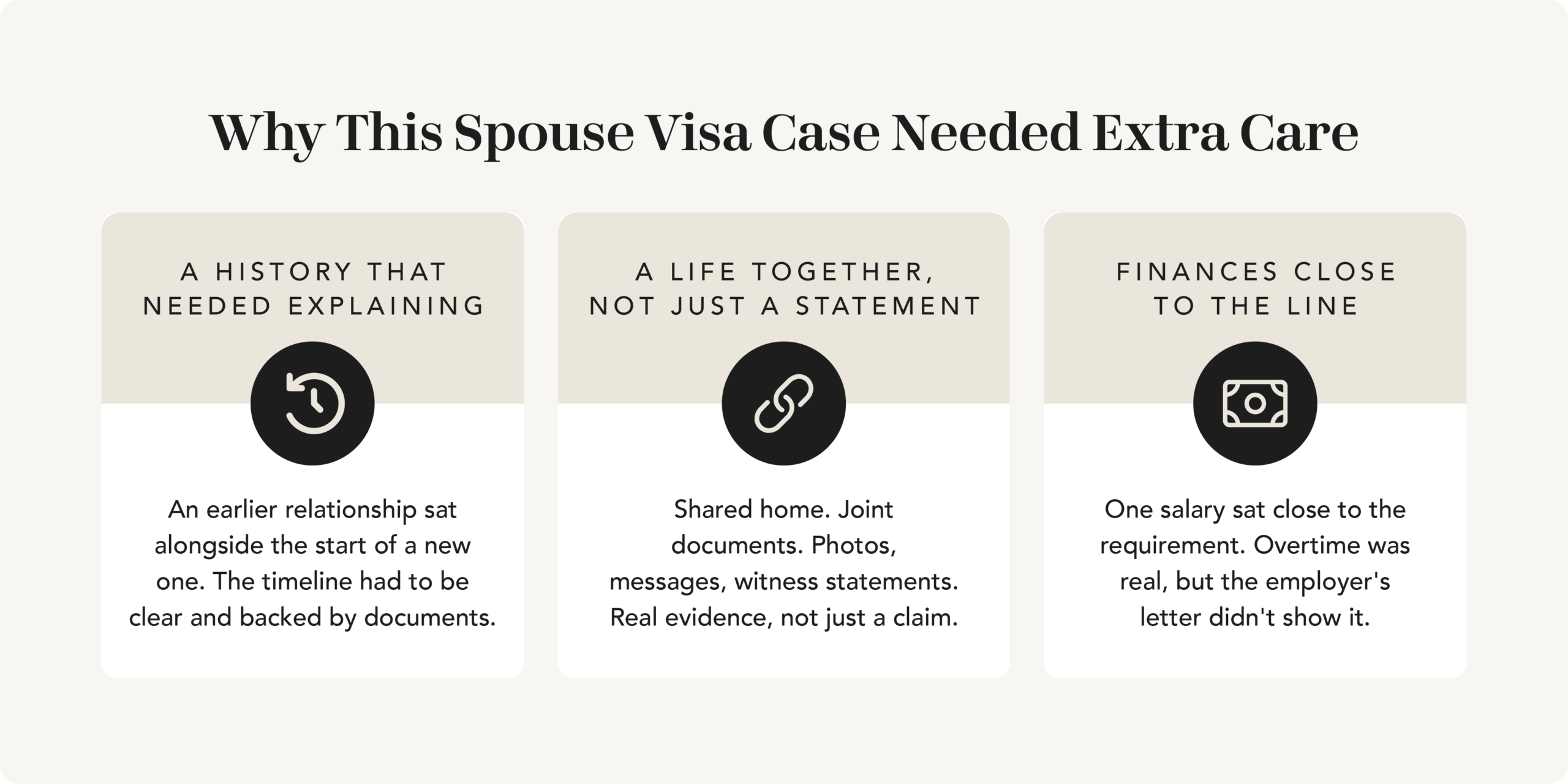
1. A relationship history that needed explaining.
An earlier relationship, and the way it ended, sat alongside the start of the new one. Any application with this kind of history invites closer scrutiny. The timeline had to be clear, consistent and backed by documents, so that a caseworker would not be left to draw their own conclusions.
2. Proving a real life together.
A genuine relationship is not shown by a statement that it exists. It is shown by the ordinary evidence of two people living as a couple:
- a shared home
- joint documents
- photographs across the years
- messages
- witness statements
That evidence had to be selected and presented so that it told one consistent story.
3. Finances close to the line.
One partner’s basic salary sat close to the required income level. Both partners worked, and both regularly earned overtime, but the employers’ reference letters showed basic pay only. Employers often issue these letters from fixed templates and will not add detail, so the gap between the letters and the real income needed to be dealt with directly.
How We Prepared the Spouse Visa Application
The case was supervised by our Principal Barrister, Mr Zainul Jafferji, with paralegals Muhammad Mohiuddin and Simran Kaur Grewal. Together they built the application around one principle: answer the Home Office’s questions before they are asked.
Every requirement, in order. The supporting letter took each requirement in turn, covering the relationship, immigration status, finances and English language, and explained how the evidence met it. A caseworker could follow the case from start to finish without piecing it together from a pile of documents.
Both incomes, fully evidenced. Because our client was in the UK and working lawfully, his income could be counted alongside his partner’s. Overtime was supported by payslips, bank statements and tax records, so the figures could be checked against real documents and not left as assertions.
Setting out the wider picture. We also explained the couple’s life in the UK and why refusing the application would interfere disproportionately with their family life. This kind of human rights argument carries weight where the facts support it, and it sat alongside the requirements, not in place of them.
Asking for flexibility. We asked the Home Office to give the couple an opportunity to provide any missing information before making a decision, so that any small documentary gap would lead to a request and not an automatic refusal.
The Outcome: Leave to Remain Granted on the Spouse Route
The Home Office granted our client leave to remain on the spouse route.
What This Spouse Visa Case Shows
Three points stand out for anyone facing a similar application.
- A complicated history is not a barrier by itself. It does mean the timeline needs to be presented clearly and backed by evidence.
- A tight financial position needs a plan. Income that sits close to the requirement should be supported with every document that shows the full picture, and gaps in employer letters should be explained, not ignored.
- Organisation matters. Applications are often judged on how easily the caseworker can follow them. Evidence that exists but is hard to follow does not help the applicant.
Every application depends on its own facts, and this outcome does not mean the same result will follow in another case. What careful preparation can do is give an application the best chance of being understood. If an application is refused, there may be options such as an immigration appeal, which is why early advice matters.
Spouse Visa Case Study: Frequently Asked Questions
Can I get a spouse visa if I have a complicated relationship history?
What does a "genuine and subsisting relationship" mean for a spouse visa?
It means the relationship is real and continuing, and that the couple live, or intend to live, together as partners. Evidence commonly includes a shared home, joint documents, photographs over time, messages and witness statements.
Can overtime count towards the spouse visa income requirement?
Can my income count towards my partner's spouse visa application?
What happens if a document is missing from my spouse visa application?
Can I instruct a barrister directly for a spouse visa application?
Yes, where it is appropriate for your case. Through the Public Access Scheme, members of the public can instruct a barrister directly without going through a solicitor first. ZH Law is barrister-led and advises on family visa applications from its London and Leicester offices.
Facing a spouse visa application that needs careful evidence?
Connect With us today on WhatsApp.
London: 0203 887 7306 | Leicester: 0116 365 6400 | enquiries@zh-law.co.uk