At a Glance
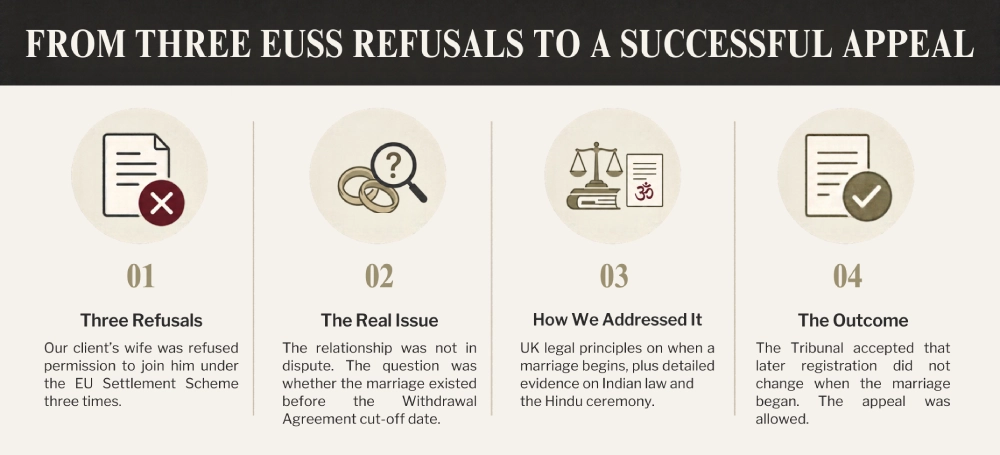
- Our client’s wife had been refused permission to join him in the UK under the EU Settlement Scheme on three separate occasions
- The genuineness of the couple’s relationship was not in dispute
- The principal issue was whether the relationship and marriage existed before the relevant Withdrawal Agreement date
- The Home Office also questioned the legal effect of the marriage having been formally registered at a later date
- We addressed the issue by reference to both UK law and detailed evidence concerning the legal position in India
- The Tribunal accepted that the later registration did not mean that the marriage only came into existence on the date of registration
- The appeal was allowed, enabling the couple finally to be reunited in the UK
What Happened
Our client’s wife had made a number of applications to join her husband in the UK under the EU Settlement Scheme. Each application was refused. The Home Office’s principal concern was not whether the couple were in a genuine relationship. That was conceded as part of the Respondent’s review in this appeal. The dispute instead centred on when the relationship and marriage had legally begun.
The couple had married in a Hindu ceremony in India before the relevant Withdrawal Agreement cut-off date. However, the marriage had not been formally registered at the time. It was only formally registered at a later stage.
The Home Office questioned whether, in those circumstances, the marriage could properly be treated as having existed from the date of the original ceremony. Its position raised a significant issue: if the later registration date were treated as the legal starting point of the marriage, the couple would fall outside the relevant EUSS requirements.That issue became the central question in the appeal.
The Key Issue: When Did the Marriage Legally Begin?
The appeal required us to address the distinction between the date on which a marriage takes place and the date on which that marriage is subsequently registered.
The Home Office’s case effectively treated the later registration as calling into question whether the marriage had existed before that date. We challenged that approach.
How We Addressed the Home Office's Concerns
The appeal required considerably more than simply producing a later-issued marriage certificate. We addressed the matter from two legal perspectives. First, we set out why, under the relevant principles applied in UK law, the fact that documentary registration occurred later did not necessarily determine the date on which the marriage itself came into existence. The correct question was whether the marriage was validly contracted under the law of the country in which it took place.
Secondly, we placed detailed evidence before the Tribunal concerning the position under Indian law and the legal effect of the Hindu marriage ceremony. This was particularly important because the later registration document itself recorded the original date of marriage. The registration was therefore relied upon not as evidence that a new marriage had been created at that later date, but as formal recognition of a marriage which had already taken place.
We also provided the evidential background explaining why the marriage had not been properly registered at the time. The Tribunal was therefore able to consider the chronology in its proper legal and factual context rather than treating the later registration date as determinative. Taken together, the evidence established that the marriage pre-dated the relevant Withdrawal Agreement date.
Why This Appeal Succeeded
The case succeeded because the appeal focused on the actual legal issue behind the refusals. There was no need to prove that the couple had suddenly become genuine partners. Their relationship itself was not in dispute.
The question was whether the marriage and family relationship relied upon for EUSS purposes existed before the relevant date. By carefully addressing the distinction between solemnisation and later registration, explaining the applicable legal principles under UK law, and placing detailed evidence before the Tribunal as to the position under Indian law, we were able to demonstrate that the later administrative registration of the marriage did not alter the fact that the couple had married earlier. The Tribunal accepted that case and allowed the appeal.
In the Client's Words
Conclusion
EUSS cases involving overseas marriages can raise difficult questions where a marriage ceremony took place before the relevant cut-off date but formal registration occurred later.
A later registration date does not necessarily mean that the marriage itself only came into existence on that date. The answer can depend upon the law governing the marriage, the nature of the ceremony, the documentary evidence and the precise requirements of the EUSS route.
In this case, those distinctions were decisive. By addressing both the UK legal position and the relevant Indian law, and by presenting the evidence showing when the marriage had actually taken place, we were able to overcome the issue which had resulted in repeated refusals. After three refused applications, the appeal was allowed and the couple can now finally be reunited in the UK.
Get Legal Advice on Your Case
If you have received an EUSS refusal, particularly where there is a dispute about the date or legal recognition of an overseas marriage or relationship, obtaining advice on the precise legal issue can make a significant difference. Every case turns on its own facts and evidence. Speak to our team to discuss your circumstances.
EUSS Appeal FAQs
Can I appeal an EUSS refusal?
Can an EUSS application be refused even if the relationship is genuine?
Does a later marriage registration mean the marriage began on that date?
Can a Hindu marriage in India count for EUSS if it was registered later?
Find out where you stand. Get in touch with ZH Law.
London: 0203 887 7306 | Leicester: 0116 365 6400 | enquiries@zh-law.co.uk