It usually begins with a date. A wedding, a birth, a graduation, or a parent whom you have not seen in years.
You open the application, and the questions multiply. How much money should be shown? Does the invitation letter matter? Is it true that nothing can be done if the application is refused? Advice from relatives, agents and online forums is often conflicting, and some of it is either out of date or untrue.
The reassuring part is that most refusals are not a matter of bad luck. They tend to follow from how an application is prepared and evidenced, which means much of the risk can be addressed before the application is submitted.
What has changed for UK visit visa applications in 2026?
The principal change is cost. Home Office fees increased on 8 April 2026. A standard visitor visa for up to six months now costs £135, and longer-term visas cost £506 (two years), £903 (five years) and £1,128 (ten years). The substantive test applied to applicants has not changed.
The fee increase matters for a practical reason. Fees are not refunded if an application is refused, or if a shorter visa is granted than the one applied for. An avoidable error is therefore more expensive than it was a year ago.
Two further points are worth noting.
First, the Electronic Travel Authorisation (ETA) scheme, which now carries a £20 fee, applies to visitors who do not need a visa to enter the UK. Nationals who require a visa, which include applicants from India and Pakistan, continue to apply for a UK visit visa in the usual way.
Second, the Home Office updated its caseworker guidance on visitors on 8 October 2026. Among other things, it clarified how the rules treat visitors who care for relatives during a visit. Where the purpose of a trip involves supporting a family member, that purpose should be described precisely and consistently across the application.
What has not changed?
The core of the application is as it was previously. A caseworker must be satisfied that the applicant is a genuine visitor. In practical terms, the applicant must show that:
- they intend to undertake only permitted activities;
- they intend to leave the UK at the end of their visit;
- they can fund the trip, and any dependants, without recourse to public funds or work; and
- they have sufficient ties to their home country to make that return credible
The burden of establishing these matters rests on the applicant. Where a caseworker is not satisfied, the application is refused.
What do people still get wrong?
Our experience across a large number of applications points to the same misunderstandings, year after year.
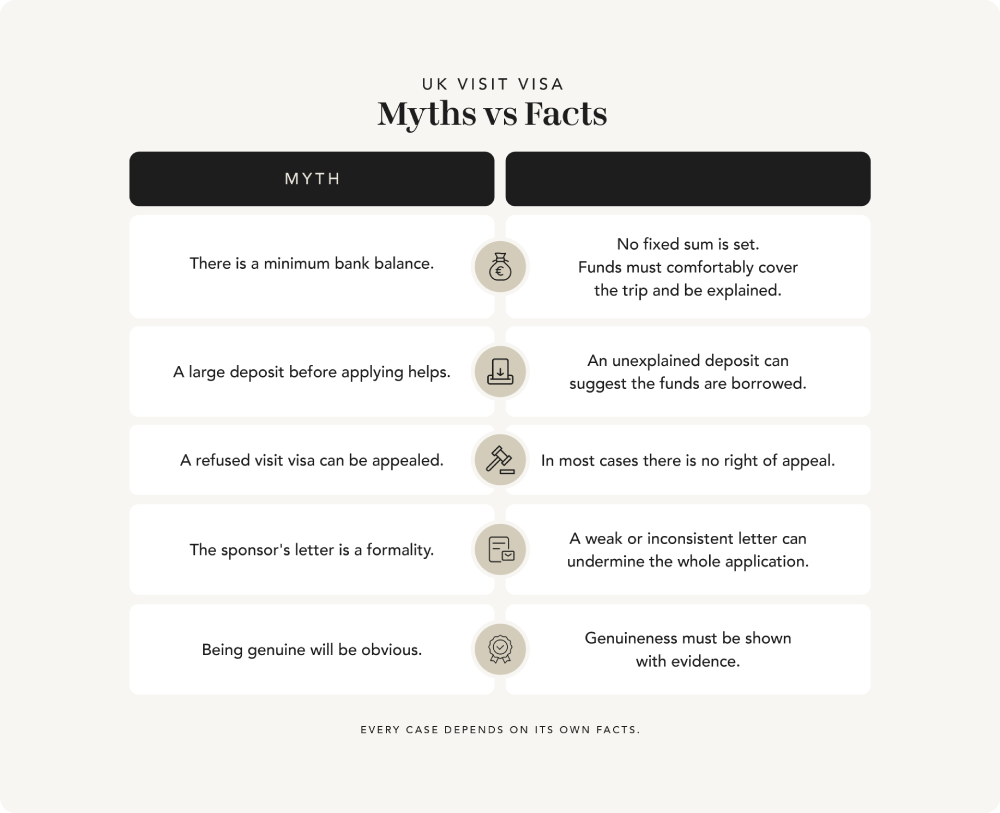
1. "There is a minimum bank balance"
2. "A large deposit just before applying will strengthen the application"
3. "If it is refused, I can appeal"
In most cases, no. Refusals of visit visas ordinarily carry no right of appeal, save for a narrow category raising human rights grounds. The principal options are to reapply, having addressed every reason given for refusal, or, in limited circumstances where the decision was legally flawed, to consider judicial review. Time limits apply to the latter, and early advice is important.
4. "The sponsor's letter is a formality"
For family visits, the sponsor’s role is substantial. A letter that is vague, unsupported, or inconsistent with the applicant’s own documents can weaken an otherwise sound application. The sponsor’s status in the UK, finances, accommodation and relationship to the applicant should each be evidenced.
5. "I am a genuine visitor, so that will be obvious"
Genuineness is not presumed; it must be demonstrated. Saying that one will return is not sufficient. Employment, family responsibilities, property, studies and a prior record of compliant travel is all evidence that must be demonstrated.
6. "I will reapply immediately with the same documents"
How long does a decision take, and when should I apply?
Applications are made online, followed by an appointment at a visa application centre to provide fingerprints and a photograph. A decision is usually made within three weeks of the application being completed, the identity checks being done and the documents being provided.
The earliest an application may be made is three months before the date of travel. For time-sensitive events, such as a wedding, it is sensible to allow a comfortable margin and not rely on the standard timeframe.
What should I do before I apply?
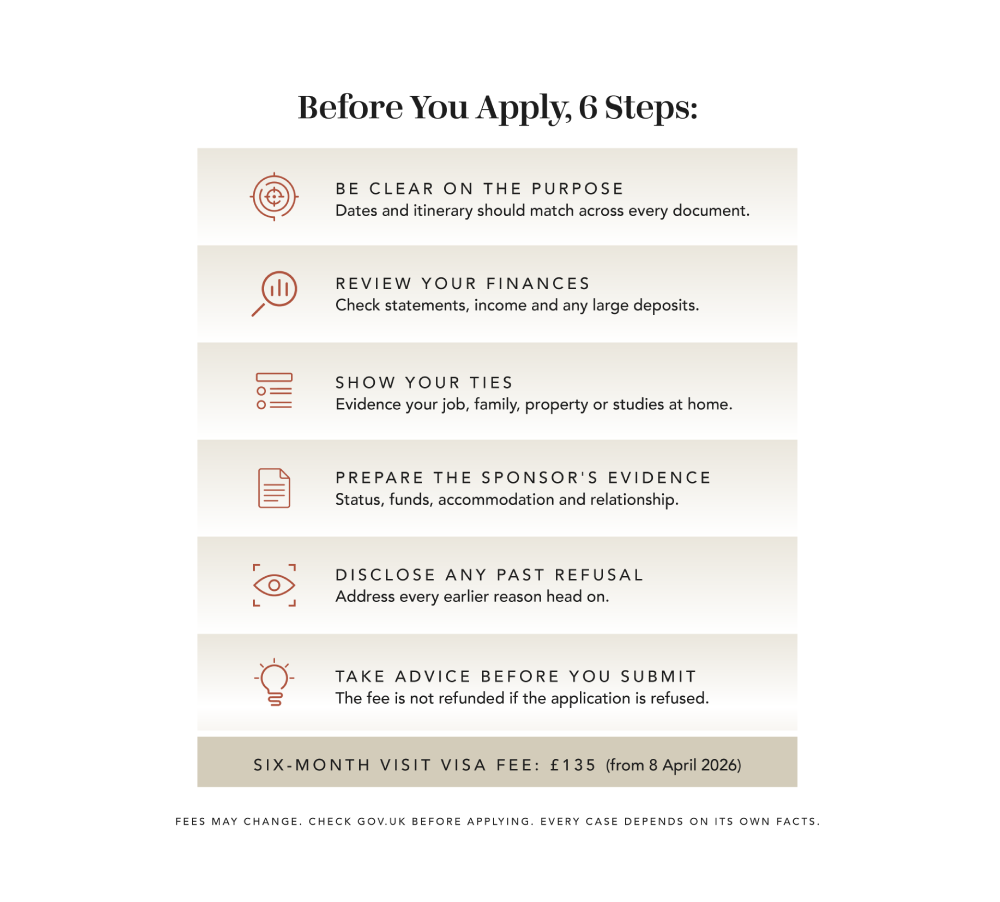
- Be clear about the purpose of the visit. The purpose, dates, and itinerary should be consistent across every document.
- Review the finances as the Home Office will. Statements, evidence of income, and any large deposits should align, and each unusual entry should be clearly explained.
- Evidence of ties to the home country. This is frequently the decisive issue.
- Prepare the sponsor’s evidence properly. Where the visit is hosted or funded, the sponsor’s documents should be complete and consistent.
- Disclose any previous refusal. Failure to do so risks a finding of misrepresentation, which can have lasting consequences.
- Obtain advice before submitting, not after refusal. The fee is not refunded, and a refusal remains on the applicant’s record.
How ZH Law can help
We advise applicants and their sponsors on visit visa applications from our offices in London and Leicester. This includes reviewing applications before submission, identifying weaknesses in the evidence, and preparing thorough evidence as well as the entire application. Where an application has been refused, we can review the refusal and advise on the options available.
Mr. Zainul Jafferji has over 27 years of experience in immigration, public law, and human rights. We understand that these applications are often tied to important family events, and we work to meet your timetable.
Frequently Asked Questions
How much does a UK visit visa cost in 2026?
Is there a minimum bank balance for a UK visit visa?
Can I appeal if my UK visit visa is refused?
Do I need a UK sponsor to visit family?
Visit visa refused, or about to apply?
Speak to Us Today.
London: 0203 887 7306 | Leicester: 0116 365 6400 | enquiries@zh-law.co.uk