A sponsor licence is essential for UK businesses that employ overseas workers under immigration routes such as the Skilled Worker route. However, having a sponsor licence alone is not sufficient. Employers must comply with the Immigration Rules, meet their sponsorship duties, maintain appropriate records, monitor sponsored workers and report relevant changes to their circumstances.
Failure to meet these obligations can have serious consequences, including the suspension or revocation of the sponsor licence. As a result, a business may lose its ability to sponsor overseas workers.
However, the consequences do not stop with the employer.
When a sponsor licence is revoked, the existing sponsored workers may suddenly find themselves facing uncertainty about their employment and their right to remain in the UK.
So, what happens when a sponsor licence is revoked? Can your business continue operating? What happens to your existing sponsored workers? Are there any options available to challenge the decision or protect the workers affected?
What can lead to the revocation of a sponsor licence?
Under the Home Office’s Workers and Temporary Workers: Guidance for Sponsors – Part 3, there are several circumstances that may lead to revocation of a sponsor licence, including:
- The business ceasing to have an active trading presence
- Failure to meet the requirements of the route under which the business is licensed
- Serious or systematic breaches of sponsor duties
- Conduct that poses a threat to immigration control
- Relevant criminal convictions or civil penalties
- Behaviour or actions considered not conducive to the public good
Importantly, a breach does not necessarily have to be deliberate or knowingly committed to result in revocation.
The Home Office further distinguishes between circumstances in which it will revoke a licence, circumstances in which it will normally revoke a licence and circumstances in which it may revoke a licence.
However, revocation is not necessarily the first action taken by the Home Office when it identifies a potential breach.
Depending on the circumstances, the Home Office may initially suspend the sponsor licence while it investigates the concerns. This gives the Home Office an opportunity to examine the suspected breaches before deciding whether further action, including revocation, is necessary.
What happens to your business when your sponsor licence is revoked?
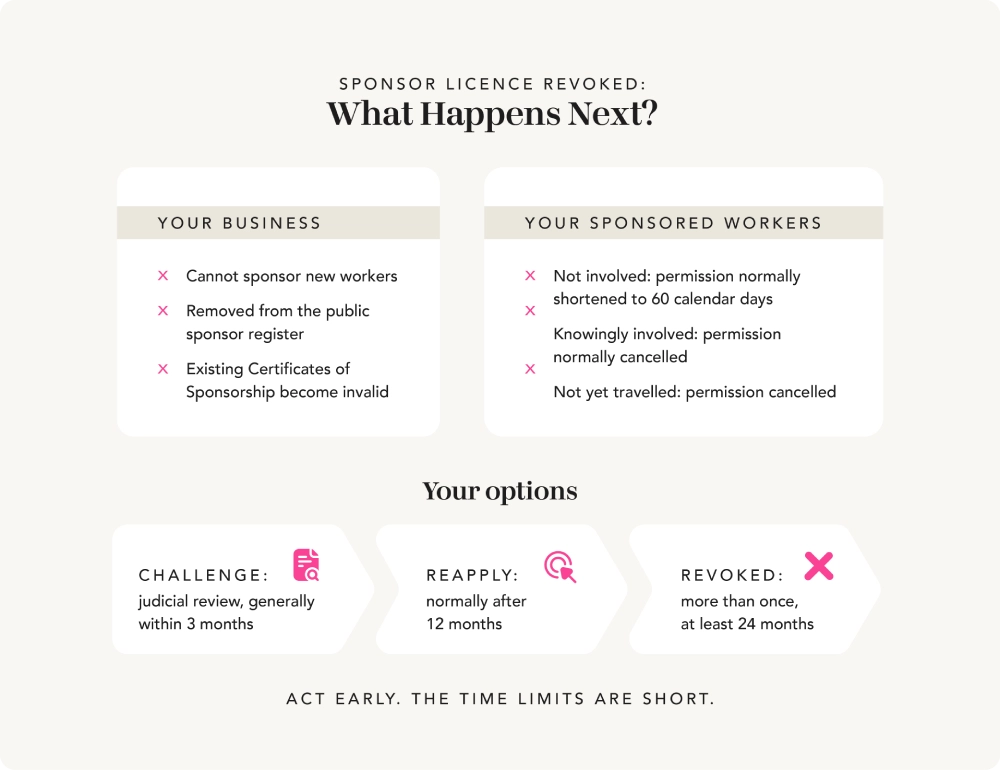
Once the sponsor licence is revoked, your business will not be able to sponsor any further workers under the routes covered by the licence.
The Home Office will remove your organisation’s details from the public register of Worker and Temporary Worker sponsors. The revocation also affects the existing sponsored workers whose immigration permission may be cancelled or shortened.
This means that any Certificate of Sponsorship previously assigned by your business would automatically become invalid.
What happens to the existing sponsored workers?
When the sponsor licence is revoked, Home Office will normally cancel or curtail the immigration permission of workers sponsored by that organisation.
The consequences depend on whether the sponsored worker was knowingly involved in the circumstances that led to revocation.
The Outcome of the Appeals
1. Where the worker was involved in the breach
If the Home Office considers that a worker was actively involved and participated in the reasons for the sponsor licence being revoked, their remaining immigration permission will normally be cancelled entirely.
This may include a situation where a worker knowingly agreed to participate in an arrangement involving a non-existent job to obtain immigration permission.
In such circumstances, the worker may be required to leave the UK immediately and could face enforcement action, including detention and enforced removal, if they remain without a valid permission.
2. Where the worker was not involved
Where the worker was not actively or knowingly involved in the circumstances leading to the revocation of their employer’s sponsor licence, the Home Office will normally curtail the existing immigration permission of the sponsored workers to 60 calendar days.
However, if the sponsored worker already has less than 60 days of permission remaining, the Home Office will generally not shorten their permission further or extend their permission to a full 60 days.
3. Where the worker has not yet travelled to the UK
Where a sponsored worker has already received entry clearance but has not yet travelled to the UK, their permission will in all likelihood be cancelled.
Similarly, where a worker has a pending immigration application based on an invalid Certificate of Sponsorship, the application may be refused.
However, the worker may be able to vary the basis of a pending application before the Home Office makes its decision. If the application is not varied in time, it will be refused.
What should sponsored workers do next?
Losing a sponsor does not necessarily mean that the sponsored workers have no other options.
1. Finding a new sponsor
During the shortened 60-day period, a sponsored worker can explore the possibility of finding another employer who holds a valid sponsor licence. However, the worker must ensure that the new role and proposed sponsorship meets the applicable requirements.
The new employer must assign a fresh Certificate of Sponsorship and the relevant immigration application must be made by the worker within the applicable period.
2. Switching to a different immigration route
Sponsored workers may be eligible to apply under another immigration route including family route and student route. Some workers may also qualify for settlement through Indefinite Leave to Remain (ILR)
However, these are not automatic alternatives. Each route has its own eligibility criteria. Before making an application, the worker must assess whether they qualify for it.
Sponsored workers should obtain advice promptly rather than waiting until the end of the shortened permission period.
3. Making arrangements for leaving UK
If the worker cannot secure another sponsor or qualify under an alternative immigration route, they should make arrangements to leave the UK before their permission to stay expires.
Remaining in the UK after immigration permission has expired may result in overstaying and could lead to immigration enforcement action.
Can you challenge the sponsor licence revocation?
There is no statutory right of appeal against a sponsor licence revocation decision.
However, you can consider challenging the decision through Judicial Review where the revocation decision was unlawful, procedurally unfair or irrational.
Judicial Review is also subject to strict time limits. A claim must be brought promptly and, in any event, generally within three months of the grounds first arising.
Can your business apply for a new sponsor licence after revocation?
If your sponsor licence has been revoked, you cannot submit another application immediately.
You will normally have to wait for a minimum of 12 months from the date of notification of the revocation before applying for a new sponsor licence.
However, this cooling-off period can be longer in certain circumstances, including where revocation was due to certain civil penalties and criminal convictions.
The minimum cooling-off period increases to at least 24 months if your business has had its sponsor licence revoked on more than one occasion.
Once the cooling-off period expires, you may submit a fresh application along with appropriate fee and supporting documents. However, the fresh application must demonstrate that the reasons for the previous revocation have been addressed.
For instance, if the previous revocation was due to dishonesty or deliberate misconduct, you must submit compelling evidence that it has been addressed and that your business is now suitable to hold a sponsor licence.
What should your business do after receiving a revocation decision?
1. Review the revocation decision
2. Assess whether the decision can be challenged
Consider whether there are legal or procedural grounds for judicial review. Any potential challenge should be assessed promptly.
3. Communicate with the existing sponsored workers
4. Review the business’s compliance systems
5. Consider a new application after the cooling-off period
How can ZH Law help?
We advise businesses and individuals on UK immigration matters, including sponsor licence compliance, sponsor licence suspension and revocation decisions and sponsored worker immigration issues. If your business has received a sponsor licence revocation decision, or if you are a sponsored worker whose immigration permission has been affected, we can help you understand the available options and the steps that need to be taken.
Mr. Zainul Jafferji has over 27 years of experience in immigration, public law and human rights. As a direct access barrister led practice, we can advise you without the need to instruct a solicitor first.
Frequently Asked Questions
What happens to your business when its sponsor licence is revoked?
Does sponsor licence revocation mean that your business must close?
What happens to sponsored workers when your sponsor licence is revoked?
Can a sponsored worker remain in the UK even after your sponsor licence is revoked?
Does the cooling-off period guarantee that a new licence will be granted?
Sponsor licence revoked?
Speak to us today.
London: 0203 887 7306 | Leicester: 0116 365 6400 | enquiries@zh-law.co.uk