

The Court of Appeal delivered an important judgment on 11 November, 2026, regarding the way civil penalties for illegal working should be assessed by the County Court. In Jen & Jamie Limited and Balbir Singh Johal v Secretary of State for the Home Department [2026] EWCA Civ 1446, the Court considered the extent to which judges can look beyond the Home Office’s Code of Practice when deciding whether a civil penalty imposed on an employer is too high.
The Court of Appeal confirmed that the court’s discretion in such an appeal is wider and the judges are entitled to consider other relevant circumstances when assessing whether the amount imposed is proportionate. This judgment is particularly significant for employers who wish to challenge the illegal working penalties.
Zainul Jafferji, Principal Barrister and Founder of ZH Law, and Barrister Sheraaz Hingora appeared for Mr Johal in the Court of Appeal, instructed by FR Solicitors. Sheraaz Hingora also represented Mr Johal in the original County Court proceedings.
The Issue Before the Court of Appeal
The appeals raised an important question about the scope of the County Court’s powers under section 17(3) of the Immigration, Asylum and Nationality Act 2006.
Under section 17, an employer can appeal against a civil penalty on specific grounds, including where the amount of the penalty is too high. The appeal shall be determined by the court having regard to the relevant provisions of the Code of Practice and any other matters it considers relevant.
However, there were different approaches adopted by the County Courts with regard to this particular issue. There was a question as to whether judges were effectively restricted to the factors identified in the Home Office Code, or whether they could also consider matters outside it when deciding whether a penalty should be reduced.
The Secretary of State for the Home Department contended that the matters which were not covered by the Code should not be taken into account. On the other hand, the appellants contended that such a restriction on the court’s discretionary power, conferred by the Parliament, would be unfair.
The Findings of the Court of Appeal:
The Court of Appeal addressed this issue directly in paragraphs 44-49 of its judgment.
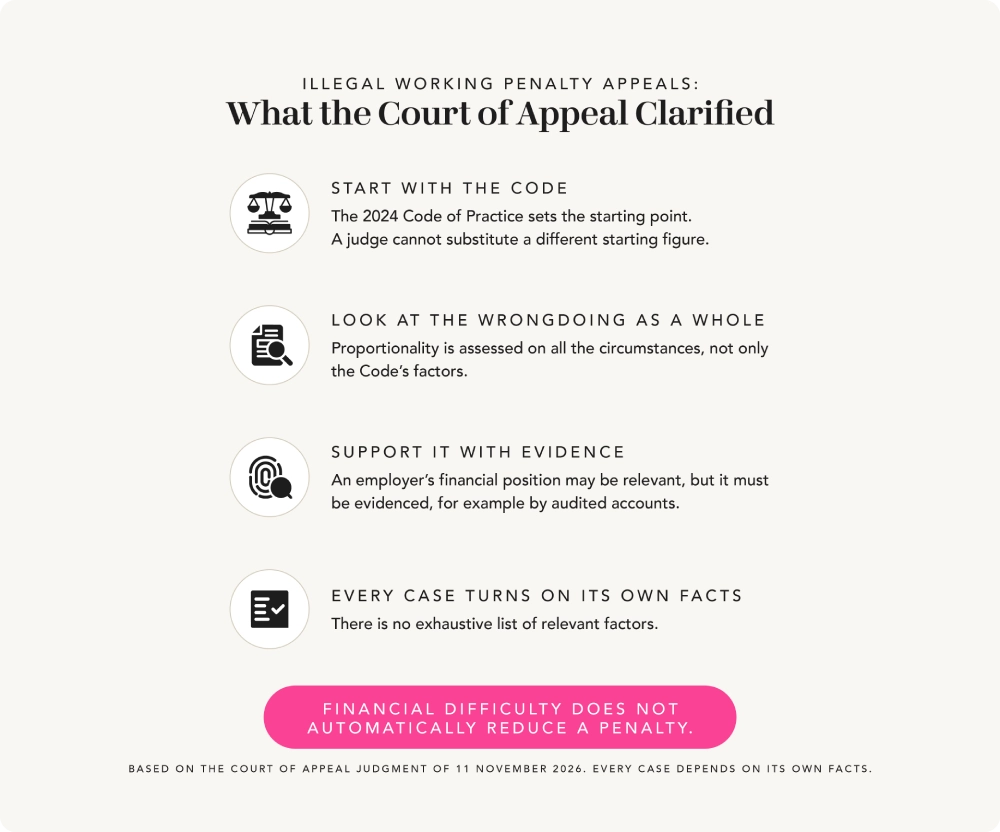
The Court explained that the question of whether a penalty is too high must be considered by reference to the level of penalty set out in the 2024 Code of Practice. It made clear that the starting point for calculating the fine must be the penalty amounts specified in the Code and a judge cannot simply disregard the prescribed penalty levels and substitute an entirely different starting figure.
However, the court emphasised that proportionality of the penalty must be assessed by looking at the wrongdoing as a whole. The Court referred to section 17(3)(b) of the Immigration, Asylum and Nationality Act 2006 and explained that judges may also consider other relevant factors when deciding whether the penalty imposed is proportionate to the conduct in question.
Importantly, the Court observed that the financial circumstances of the employer may be relevant when deciding the appropriate financial penalty.
However, the employer cannot simply assert that the penalty is too high and expect it to be reduced. The financial circumstances must be supported by relevant evidence. This may include the audited accounts of the employer’s business for the preceding years.
The Court further recognised that it would not be appropriate to provide an exhaustive list of every factor that might be relevant in a civil penalty appeal. The circumstances of each case will differ. A factor that is important in one appeal may carry little or no weight in another.
Therefore, judges must consider the particular facts, the provisions of the Code, and any other relevant circumstances before reaching a decision.
What Does This Mean for the Employers?
The judgment confirms that an appeal challenging the amount of illegal working penalty is not limited solely to how the Home Office calculates the penalty under the Code of Practice.
The court may consider other matters relevant to the circumstances of the case, and the employers may be able to submit evidence concerning their financial position, the cumulative effect of multiple penalties, and other matters relevant to their circumstances.
However, this does not mean that penalties will automatically be reduced whenever an employer experiences financial difficulty. The court will assess the circumstances of each case individually.
The Outcome of the Appeals
Following its consideration of these issues, the Court of Appeal granted permission to the appellants to amend their grounds of appeal.
In Mr Johal’s appeal, the Secretary of State for the Home Department withdrew the original penalty notice and subsequently issued a new penalty notice. The Court therefore allowed the appeal.
In the appeal brought by Jen & Jamie Limited, the Court allowed the appeal to the extent that the matter could be returned to the County Court for it to determine whether the amount of the penalty was too high, applying the approach explained in the judgment.
How ZH Law Can Help
We advise and represent employers in matters involving illegal working civil penalties, statutory appeals and related immigration law issues. Receiving a civil penalty notice for illegal working can have serious financial consequences for a business. The amount imposed may be substantial, particularly where more than one worker is involved. We advise on the available grounds of appeal and the evidence that may be relevant when challenging a penalty.
Mr. Zainul Jafferji has over 27 years of experience in immigration, public law and human rights. As a direct-access barrister practice, we can advise you without the need to instruct a solicitor first.
Frequently Asked Questions
Can an employer appeal against a civil penalty for illegal working?
Can the County Court consider factors outside the Home Office Code of Practice when assessing a penalty?
Can an employer’s financial circumstances be considered when challenging an illegal working penalty?
Will an illegal working penalty automatically be reduced if the employer is facing financial difficulties?
Received a civil penalty notice for illegal working?
Speak to us today
London: 0203 887 7306 | Leicester: 0116 365 6400 | enquiries@zh-law.co.uk