
A breach of contract rarely announces itself as a legal dispute. It may begin with goods that fail to arrive, work left unfinished, or a payment that remains outstanding long after the agreed deadline. Explanations are offered, assurances are given, and deadlines pass without resolution.
You return to the contract to establish precisely what was agreed and where matters have gone wrong. The immediate concern is rarely confined to the breach itself. There are wider consequences for your business, your customers, your finances and the obligations you may owe to others.
The question then becomes what steps you can take to protect your position. English contract law provides a range of remedies where contractual obligations have not been honoured. However, the remedies available, and the steps required to preserve them, depend upon the nature of the breach, the terms of the agreement and the action taken in response. Decisions made at an early stage can have significant consequences for the eventual outcome.
What constitutes a breach of contract?
A breach of contract arises where one party fails, without lawful justification, to perform an obligation imposed by the agreement. This may involve a complete failure to perform, delay in performance, defective performance, or an unequivocal indication that a contractual obligation will not be fulfilled when the time for performance arrives.
Not every breach, however, carries the same legal consequences. An ordinary breach may entitle the innocent party to claim damages, without giving rise to a right to terminate the agreement. By contrast, a repudiatory breach may entitle the innocent party to treat the contract as discharged from further performance and pursue a claim for damages.
Whether a breach is repudiatory depends upon the proper construction of the contract, the nature of the obligation breached and, where relevant, the seriousness of the consequences. A breach which appears commercially significant will not necessarily justify termination as a matter of law. This distinction is important. A party who purports to terminate a contract without sufficient legal grounds may itself commit a repudiatory breach. The decision to terminate should therefore be taken only after careful consideration of the contractual terms and the circumstances.
How long do you have to bring a claim?
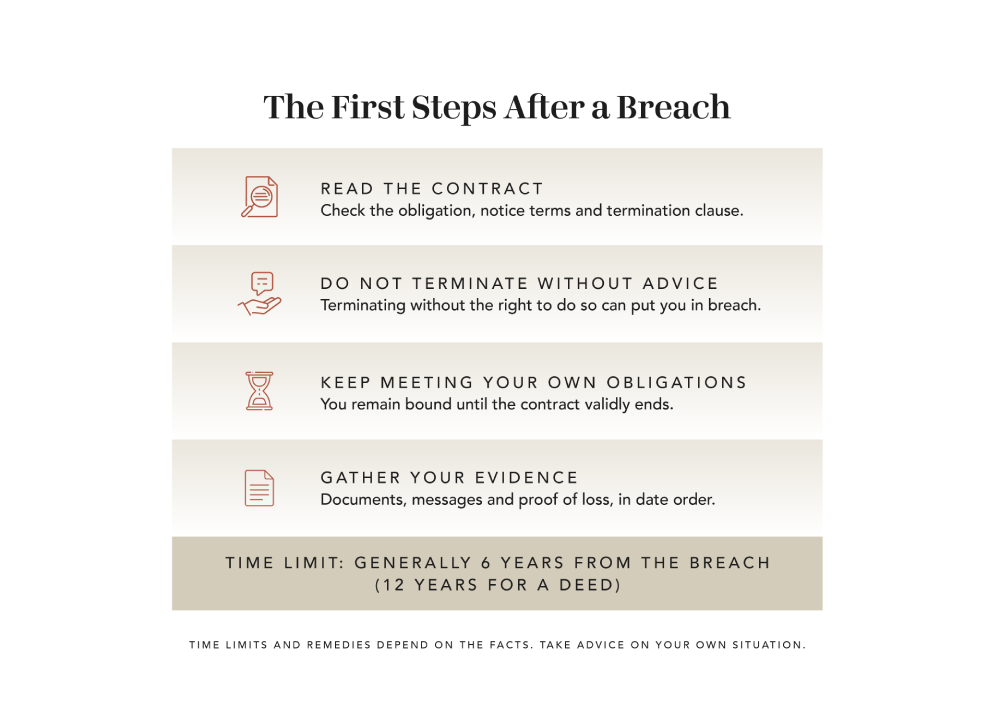
The Limitation Act 1980 prescribes the periods within which proceedings for breach of contract must ordinarily be commenced. For claims arising under a simple contract, the limitation period is generally six years from the date on which the cause of action accrued. Where the claim arises under a contract executed as a deed, the applicable period is generally twelve years.
Importantly, time will ordinarily begin to run when the breach occurs, rather than when the innocent party first becomes aware of it. A party may therefore find that a substantial part of the limitation period has already elapsed before the full financial consequences of the breach become apparent.
The expiry of the applicable limitation period may provide the defendant with a complete defence to an otherwise meritorious claim. Where a dispute concerns events some years in the past, obtaining timely legal advice is therefore essential.
What remedies are available for breach of contract?
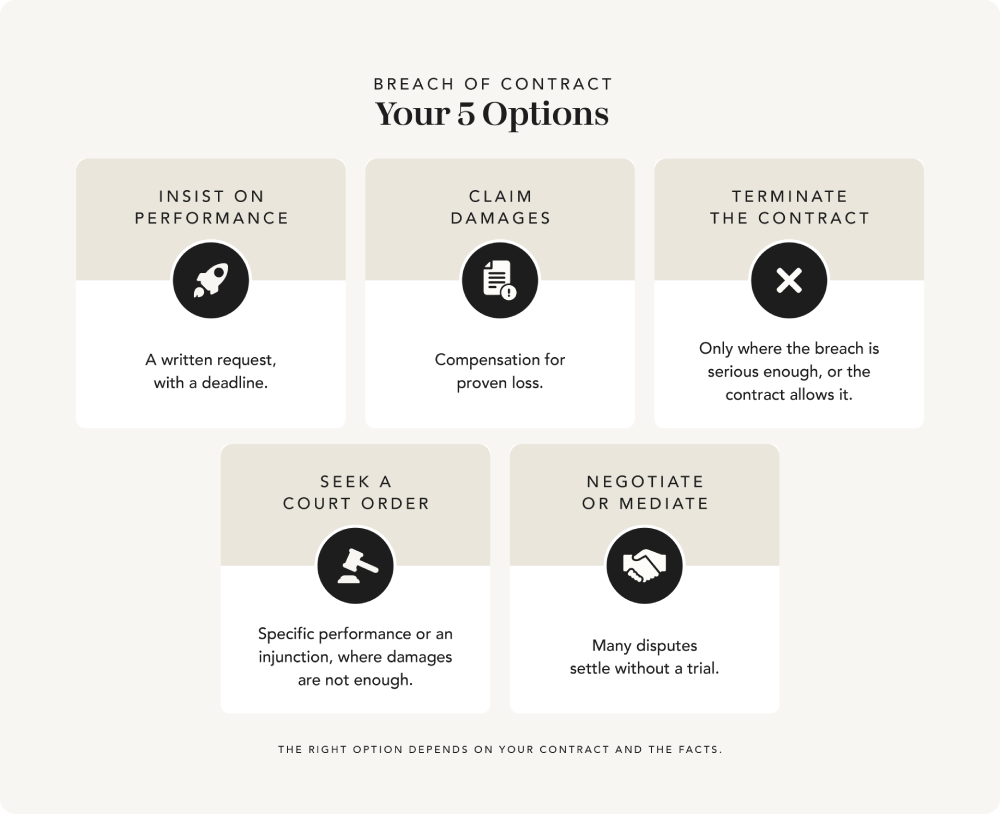
The appropriate remedy will depend upon the terms of the agreement, the nature and seriousness of the breach, the loss suffered and the outcome the innocent party seeks to achieve. Depending upon the circumstances, the available options may include:
- Requiring performance: Calling upon the defaulting party to fulfil its outstanding contractual obligations within a specified period.
- Claiming damages: Seeking financial compensation for losses arising from the breach.
- Terminating the contract: Bringing the agreement to an end where the breach is repudiatory or an express contractual right of termination has arisen.
- Seeking specific performance or an injunction: Applying to the court for an order compelling the performance of a contractual obligation or restraining conduct contrary to the agreement.
- Negotiating a settlement: Seeking to resolve the dispute through direct negotiation, mediation or another form of alternative dispute resolution.
Damages are the principal remedy for breach of contract. Their purpose is generally to place the innocent party, so far as an award of money can achieve it, in the position it would have occupied had the contract been properly performed. However, compensation is not automatic. The claimant must establish the breach, demonstrate the loss caused by it and satisfy the applicable principles governing causation and remoteness. The claimant is also expected to take reasonable steps to mitigate its loss.
Specific performance and injunctions are equitable remedies granted at the court’s discretion. They will not ordinarily be available where damages would provide an adequate remedy. The choice of remedy is therefore not merely a question of preference. It requires a considered assessment of the parties’ contractual rights, the available evidence and the practical consequences of pursuing each course.
In many cases, the most effective approach is to identify the breach promptly, preserve the relevant evidence and take proportionate steps towards resolution before the dispute escalates into formal proceedings.
What Constitutes a Breach of Contract?
A breach of contract occurs where a party fails, without lawful justification, to perform an obligation imposed upon it by the terms of the agreement. The breach may concern an express contractual term or, in appropriate circumstances, a term implied by law. Common examples include:
- Failure to supply goods or services in accordance with the agreement.
- Delay in completing contractual work or performance falling below the required standard.
- Failure to make payment by the contractually agreed date.
- An unequivocal indication, before performance is due, that a party will not fulfil its contractual obligations.
- Failure to comply with a particular contractual restriction or obligation, such as an exclusivity or confidentiality clause.
Importantly, a breach of contract does not ordinarily require proof of dishonesty, bad faith or an intention to disregard the agreement. A party may be in breach notwithstanding that its failure arose from financial difficulties, misunderstanding or circumstances outside its immediate control, unless those circumstances afford a recognised contractual or legal excuse.
The reasons for the breach may nevertheless be relevant to the parties’ assessment of the dispute, particularly when considering whether it can be resolved through negotiation or whether formal proceedings are necessary.
What Should You Do Immediately Following a Breach?
1. Examine the Contract and Identify the Obligation Breached
The starting point is the agreement itself. Before alleging a breach, it is necessary to identify precisely what the other party was obliged to do, when that obligation arose and the respects in which it has not been fulfilled. Particular attention should be paid to provisions governing performance, notice requirements, opportunities to remedy a breach, termination, limitations or exclusions of liability and dispute resolution.
The wording of these provisions can be decisive. A contractual right may be lost, or its exercise challenged, where the prescribed procedure has not been followed. It is equally important to consider whether the agreement has been varied, whether formally or through subsequent dealings between the parties.
2. Exercise Caution Before Terminating the Agreement
Termination is among the most consequential steps available to an innocent party. It should not be undertaken merely because the other party has failed to perform an obligation. Not every breach confers a right to terminate. That right may arise under an express contractual provision or where the breach is sufficiently serious to amount to a repudiatory breach.
A party who purports to terminate without lawful entitlement may itself commit a repudiatory breach, exposing it to a claim for damages. There is a further consideration. Where an innocent party has a right to terminate for repudiatory breach, its subsequent conduct may amount to an affirmation of the contract, with the consequence that the right to terminate for that breach may be lost.
The decision whether to terminate, affirm the contract or allow an opportunity to remedy the breach therefore requires careful consideration. Legal advice should ordinarily be obtained before any unequivocal election is communicated.
3. Continue to Comply with Your Own Contractual Obligations
A breach by one party does not necessarily release the other from its obligations. Unless the contract has been validly terminated, performance has lawfully been suspended, or there is some other recognised basis for withholding performance, the innocent party may remain bound to fulfil its own obligations.
Unilaterally withholding payment, suspending services or refusing to perform without a contractual or legal entitlement may expose that party to a separate allegation of breach. The proper course is to establish what obligations remain enforceable and whether the agreement permits any suspension or withholding of performance.
4. Preserve and Organise the Evidence
A successful contractual claim depends not merely upon establishing that a breach occurred, but upon demonstrating the contractual obligation, the failure to perform it and, where damages are sought, the resulting loss.
Relevant evidence should therefore be preserved at the earliest opportunity. This will ordinarily include the contract and any subsequent variations, correspondence between the parties, invoices, payment records, delivery documents, progress reports and contemporaneous records of the alleged breach.
Documents should be organised chronologically, with particular attention to any assurances given, deadlines agreed, complaints raised and opportunities afforded to remedy the breach. Where the agreement was concluded orally, contemporaneous correspondence, messages, invoices and evidence of the parties’ conduct may be particularly important in establishing its terms.
It is also essential to preserve evidence of financial loss, including expenditure incurred, payments withheld, additional costs and any demonstrable loss of profit. Careful record-keeping at this stage will assist not only in assessing the merits and value of a potential claim, but also in identifying whether the dispute can be resolved without recourse to litigation.
What happens after you write to the other side?
Before a claim is issued, the court expects the parties to follow the Practice Direction on Pre-Action Conduct. In practice, this means sending a letter setting out your claim, the documents you rely on and what you want, and allowing a reasonable period for a response. In a straightforward case, that is usually around 14 days.
The other side may then agree to perform, make an offer, dispute the claim, or not respond. The parties may attempt negotiation or mediation, and the court expects them to consider it. If the matter does not resolve, proceedings can be issued. Costs risk, and in business debts, interest, should be weighed before that step. There is no guarantee of any particular outcome, which is why the quality of the early correspondence and evidence is important.
How ZH Law can help
We advise individuals and businesses in civil disputes from our offices in London and Leicester, from early assessment and pre-action correspondence through to formal proceedings where required. We review your contract and the circumstances of the breach, advise on prospects, risk and strategy, and prepare the correspondence on your behalf where appropriate.
Mr. Zainul Jafferji has over 27 years of experience in complex and contentious matters, and our barristers can be instructed directly through the Public Access Scheme. We understand that disputes of this kind are often time-sensitive, and we work to meet your deadlines. See our civil litigation page and our fee structure page for how our fees are arranged.
Frequently Asked Questions
What is the time limit for a breach of contract claim?
Can I claim compensation if the other side does not deliver?
You can, depending on the circumstances. Damages aim to put you in the position you would have been in had the contract been performed. You must prove your loss and take reasonable steps to limit it.
Do I have to write to the other side before issuing a claim?
Can I terminate the contract if the other side fails to deliver?
Only if the breach is serious enough, or the contract gives you a right to terminate. Terminating without that right can place you in breach, so check your position first.
Contract dispute and unsure where you stand?
Speak to Us Today.
London: 0203 887 7306 | Leicester: 0116 365 6400 | enquiries@zh-law.co.uk