
Few situations in immigration law are more frightening than being detained.
A person can find themselves detained in an Immigration Removal Centre (IRC), a temporary holding facility, or even in prison after serving a criminal sentence. For many, the route to release is immigration bail.
Despite the name, immigration bail bears little resemblance to criminal bail. It is a separate administrative and legal process with its own legislation, policy, evidence, and strategy. Get it wrong and a person may be detained for weeks, or even months, unnecessarily. This article explains what immigration bail is, who can apply, how the process works, and why specialist legal representation can make the difference.
What is immigration bail?
Immigration bail is an arrangement that allows a person who has been detained under immigration powers, or who is liable to be detained, to live in the community subject to conditions. It is governed by Schedule 10 to the Immigration Act 2016, which came into force in January 2018, replacing the older patchwork of temporary admission, temporary release, and release on restrictions.
Three points are widely misunderstood:
- Bail is not immigration status. Being on bail does not grant leave to remain and does not resolve the underlying immigration case.
- Bail is not only for those in detention. Some people who are liable to detention, but not currently held, may also be on immigration bail with conditions attached.
- Bail does not usually permit work. Work and study are restricted by default. Any permission depends on the person’s circumstances and the conditions imposed.
Who can apply for immigration bail?
In general, anyone held under immigration powers, or who may become subject to them, can apply for immigration bail. Eligibility to apply is broad, though whether bail is granted depends heavily on the facts of each case.
Those who commonly apply include:
- People held in an IRC while the Home Office reviews their removal, deportation, or asylum case
- Asylum seekers detained during the asylum process
- Foreign nationals detained under immigration powers after a criminal sentence, pending deportation
- People facing removal who are unlikely to be removed in the near future
- Vulnerable people, including survivors of torture or trafficking, those with serious physical or mental health conditions, and others identified as “adults at risk” under statutory guidance
Not everyone has the same practical prospects. Whether bail is granted depends on factors including immigration history, any criminal record, community ties, available accommodation, and the realistic prospect of removal.
The two routes: Home Office or Tribunal
There are two main ways to seek immigration bail.
1. Applying to the Home Office. A detained person can ask the Home Office to grant bail. This can be quicker and less formal, and in some cases avoids a hearing. However, Home Office decisions can be inconsistent, and refusals are common, particularly where there is previous offending or a perceived risk of absconding.
2. Applying to the First-tier Tribunal (Immigration and Asylum Chamber). Here an independent judge decides after hearing both sides. Key features include:
- Hearings are often held remotely by video link from the detention centre, though in-person hearings are possible
- A Home Office Presenting Officer usually opposes the application and files a bail summary setting out the Home Office’s reasons
- Hearings for detained applicants are usually listed within a few working days
- If bail is refused, a repeat application generally requires a material change in circumstances, so a poorly prepared application that is refused can make the next attempt harder
- Where removal directions are set within 14 days, the Tribunal’s power to grant bail is restricted and the Home Office’s consent may be needed
- A refusal does not necessarily end matters, as the Home Office may still grant bail itself, and unlawful detention can be challenged separately in the High Court
What do decision-makers look for?
Whether it is the Home Office or the Tribunal deciding, the central question is whether the person can be safely released and whether they will comply. The main considerations are:
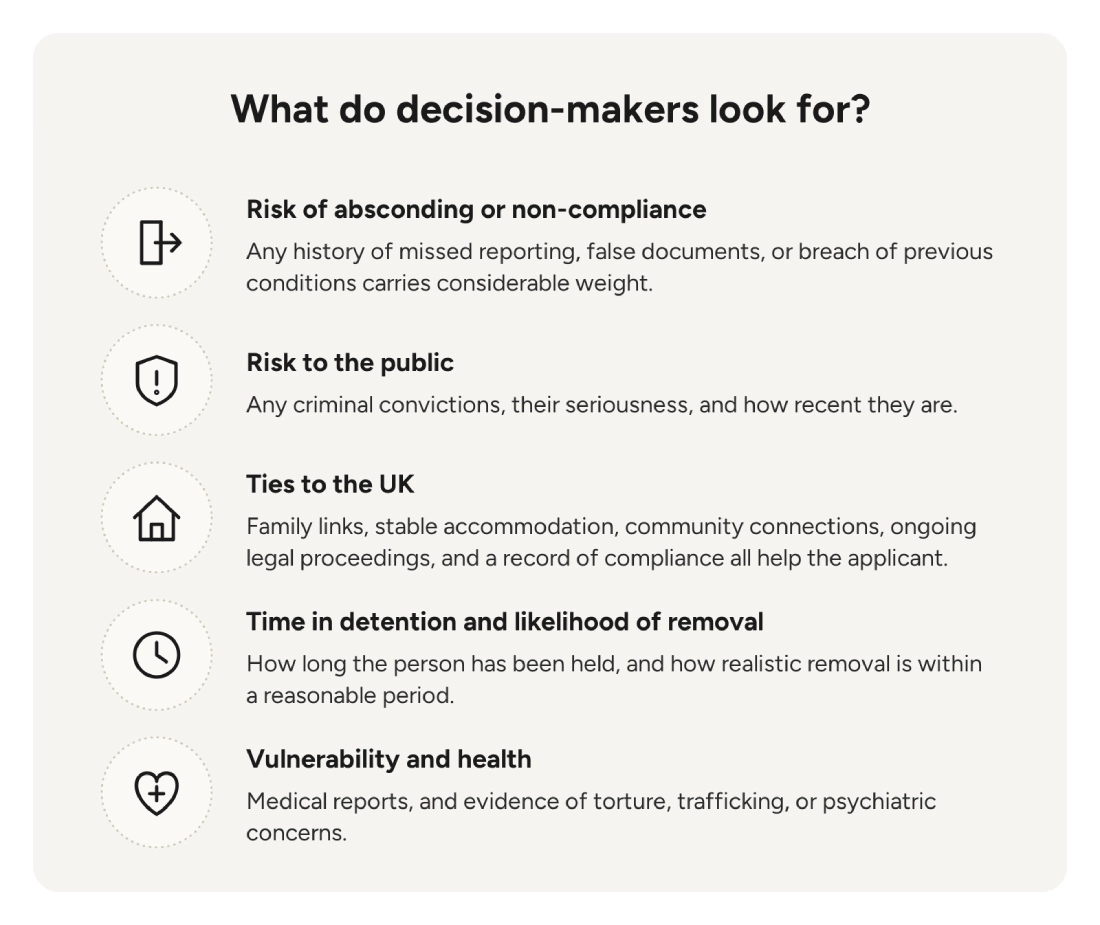
- Risk of absconding or non-compliance. Any history of missed reporting, false documents, or breach of previous conditions carries considerable weight.
- Risk to the public. Any criminal convictions, their seriousness, and how recent they are.
- Ties to the UK. Family links, stable accommodation, community connections, ongoing legal proceedings, and a record of compliance all help the applicant.
- Time in detention and likelihood of removal. How long the person has been held, and how realistic removal is within a reasonable period.
- Vulnerability and health. Medical reports, and evidence of torture, trafficking, or psychiatric concerns.
Detention must be lawful: the Hardial Singh principles
Bail applications often sit alongside a wider argument that the detention itself has become unlawful. Under the Hardial Singh principles, the Home Office may detain only where:
- It intends to remove or deport the person and uses the power for that purpose
- Detention lasts only for a period that is reasonable in all the circumstances
- Detention ends once it becomes clear removal is not realistically possible within a reasonable period
- The Home Office acts with reasonable diligence and expedition
Where these principles are breached, bail may be only part of the answer. Claims for unlawful detention, including compensation, may also be available. Recent legislation such as the Illegal Migration Act 2023 has changed aspects of detention and bail, so current law should be checked on the facts of each case.
Conditions attached to bail
Immigration bail is rarely unconditional. Typical conditions include:
- Residence at a specified address
- Reporting to an immigration office or police station, often weekly or fortnightly
- Electronic monitoring (a GPS tag), particularly for foreign national offenders or higher-risk cases
- Curfews or travel restrictions
- Restrictions on work and study
- Financial conditions, where a supporter pledges a sum that may be forfeited if bail is breached (usually not paid upfront)
Breaching a condition can lead to further detention, loss of any pledged money, and harm to future applications. Some breaches may also amount to a criminal offence, so it is essential to understand the exact requirements
Accommodation: a common obstacle
Special protections
Several groups benefit from additional safeguards:
- Adults at risk. Statutory guidance under the Immigration Act 2016 requires the Home Office to weigh vulnerability evidence when deciding whether, and for how long, to detain.
- Rule 35 reports. Under the Detention Centre Rules 2001, doctors in IRCs must report concerns about torture, serious illness, or suicide risk. These reports can be pivotal evidence.
- Pregnant women. Detention is generally limited to 72 hours, extendable to seven days with ministerial approval.
- Children. Unaccompanied children cannot be held in the ordinary detention estate, and family detention is tightly restricted.
Why specialist help matters
Anyone can, in theory, make a bail application. In practice, the gap between a well-prepared, well-evidenced application and one made by an unrepresented person can be the difference between release and months of continued detention. Specialist help matters because:
The law is complex and constantly changing. Schedule 10, Home Office policy, Tribunal rulings, case law, and recent legislation are best navigated with professional training, especially for someone in detention with limited access to documents or the internet.
Evidence wins the case. A strong application should include evidence of accommodation, supporting letters, identity and relationship documents, medical and psychological evidence, a record of compliance, and credible supporters.
Risk arguments must be answered. The Home Office bail summary may overstate the risk of absconding or danger. A specialist can challenge weak claims, address past issues openly, and propose conditions, such as reporting or tagging, that meet the Home Office’s concerns.
Timing and strategy are decisive. Whether to apply to the Home Office first, when to go to the Tribunal, and whether to wait to gather stronger evidence are all judgment calls with real consequences if a refusal follows.
Bail connects to the wider case. A bail application does not sit in isolation. An adviser who understands the asylum, human rights, or deportation case can avoid contradictions between proceedings.
Unlawful detention may be in play. A specialist can identify when detention has become unlawful and pursue judicial review, habeas corpus, or damages, which can add pressure to secure release.
Supporters must be prepared. Financial supporters may be cross-examined on their relationship to the applicant, their finances, and their understanding of the obligations. An unprepared supporter can undermine even a strong application.
Legal aid may be available. Many detainees can access free initial advice through the Detention Duty Advice Scheme in IRCs, and many applicants may be eligible for legal aid, subject to merits and means. It is advisable to choose an adviser regulated by the Solicitors Regulation Authority (SRA), the Bar Standards Board (BSB), or the Immigration Advice Authority (IAA, formerly the OISC).
How ZH Law can help
We advise and represent people in immigration detention and their families on bail applications to both the Home Office and the First-tier Tribunal, preparing the evidence, addressing the Home Office’s risk arguments, and challenging unlawful detention where appropriate.
Mr. Zainul Jafferji has over 27 years of experience in immigration, public law and human rights. As a direct access barrister practice regulated by the Bar Standards Board, we can represent you directly, without the need to instruct a solicitor first.
Frequently Asked Questions
Does immigration bail give me the right to stay in the UK?
How quickly can a bail hearing happen?
Can I work if I am on immigration bail?
What happens if a bail application is refused?
You or a loved one detained and seeking release?
Speak to Us Today.
London: 0203 887 7306 | Leicester: 0116 365 6400 | enquiries@zh-law.co.uk