
The legal meaning of “employer” for right to work purposes has widened well beyond traditional employment. That means the reach of civil penalties is wider than ever, and relying on your old right to work routine may no longer be enough. The risk can now travel up the chain to agencies, platforms and main contractors, even where they never held a contract with the person doing the work.
So how do you protect your business when you have no direct contract with the person? The answer lies in what you can show you did before the work started.
What changed on 1 October 2026?
From 1 October 2026, the UK illegal working regime applies beyond direct employees to a much wider range of working arrangements, including agency workers, gig economy and platform workers, and individual subcontractors. The change was made by Section 48 of the Border Security, Asylum and Immigration Act 2025, which came into force under the Commencement No. 4 Regulations 2026 (SI 2026/683) alongside a revised Code of Practice.
Under UK immigration law, every employer carries a legal duty to prevent illegal working. Until recently, that duty, and the civil penalties for failing to meet it, applied almost exclusively to direct payroll employees. Section 48 amends the Immigration, Asylum and Nationality Act 2006 and extends both compliance obligations and civil penalty exposure to a far broader set of working relationships.
Who may now be liable under the 2026 framework?
The arrangements now in scope include the following.
Worker’s contract. Any business directly engaging people who do the work personally under a contract that is not regular employment, and who are not running their own business.
Individual subcontractors. Any business that contracts to deliver work to a customer and outsources part of the service down a subcontracting chain.
Online matching services and gig platforms. Websites or apps that maintain a register of service providers, match them with clients for a fee or commission, and facilitate service delivery.
Engagers permitting substitution. Any platform, agency or business whose contractual arrangements allow a worker to send a substitute or replacement to perform the work.
Subcontracting chains. Any business contracted to deliver work or services to a customer that subcontracts part or all of that work down a supply chain, where liability for illegal working may pass up to upstream contractors.
What did compliance look like before 1 October 2026?
To understand how significant the 2026 shift is, it helps to look at how right to work compliance worked before the amendment.
Civil penalty liability applied almost exclusively to direct payroll employees working under traditional contracts of employment. For non-payroll arrangements, such as self-employed freelancers, agency temps, gig workers and subcontractors, engaging businesses were generally not required to establish a statutory excuse under the civil penalty regime.
As a result, the compliance mechanism was built on the assumption that right to work checks were needed only for workers on the payroll. Because there was no concept of extended liability, being unaware of downstream hiring practices carried little civil penalty risk.
The new framework closes that gap. Avoiding a civil penalty now calls for oversight across your entire workforce and supply chain, because a lack of awareness may no longer protect you.
How does liability trigger under the new framework?
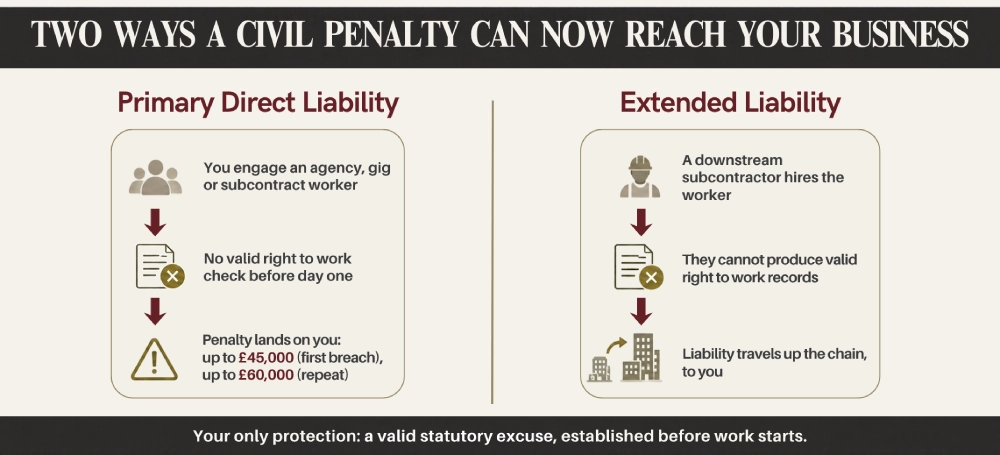
Primary direct liability.
Extended liability.
This is where exposure can arise less visibly. Your business may be liable for a civil penalty even where you are unaware of the individual performing work on your behalf. Immigration Enforcement will initially look to the direct employer who engaged the worker. However, where that downstream subcontractor cannot be located or verified, and fails to produce valid right to work records, liability may pass up the contractual chain. Basic paper warranties from suppliers promising compliance may not be enough on their own, unless your business can demonstrate a valid statutory excuse established before the work began.
What does it take to establish a statutory excuse?
A statutory excuse is your business’s main legal protection against a civil penalty. What it takes to establish one depends on the type of arrangement.
For direct engagements. You should carry out a prescribed manual document check, a Home Office online right to work check, or a certified digital identity check before the work commences, and keep dated, tamper-evident records for the duration of the engagement plus two years.
For extended supply chains and non-direct engagements. To support a statutory excuse against extended liability, a business should put three elements in place before work starts and be able to show they operate effectively in practice:
- Written agreements that require downstream checks, prohibit unapproved subcontracting, preserve audit rights, allow termination for non-compliance, and require cooperation with Home Office investigations
- Processes ensuring any substitutes are checked before day one, with no delegation of checking duties to the worker
- Proportionate site controls confirming that the person doing the work is the exact person who was checked
Who is still outside scope?
The new framework is aimed at personal labour supply rather than genuine commercial trade.
The following arrangements generally do not require a right to work check:
- Independent contractors operating a business on their own account, who serve multiple clients, set their own fees and bear commercial risk
- Business to business contracts for the supply of services, rather than the engagement of an individual to carry out work personally
- Businesses acting purely as the end user
- Work or services not carried out in the UK
- Existing employee and contractor arrangements entered into before 1 October 2026.
How ZH Law can help
ZH Law advises employers on all aspects of right to work compliance, supply chain liability and illegal working civil penalties under the 2026 reforms. We can assist your business with:
- Auditing workforce arrangements and onboarding procedures
- Preparing your organisation for Home Office compliance inspections
- Reviewing and redrafting commercial contracts to support a valid statutory excuse
- Advising on complex worker classification questions
- Advising sponsor licence holders on their wider duties, to help protect the licence from suspension or revocation
- Challenging civil penalty notices and representing organisations in enforcement action
Mr. Zainul Jafferji our principal barrister has over 27 years of experience in immigration and public law. We help businesses adapt to the new framework before an issue arises, and respond where enforcement action has already begun.
Frequently Asked Questions
When did the new right to work rules come into force?
Do I need right to work checks for agency and gig workers now?
Can my business be fined for a worker I did not directly hire?
How much is the civil penalty under the new rules?
Does a supplier’s promise to check workers protect me?
Unsure how the new rules affect your workforce or supply chain?
Speak to Us Today.
London: 0203 887 7306 | Leicester: 0116 365 6400 | enquiries@zh-law.co.uk