You may have received a refusal letter for a visit visa from the Home Office. You may have opened it and read it multiple times and still been left wondering what went wrong. This can be confusing when you think you have submitted all the required documents such as: bank statements, employment documents, travel history documents, etc.
The refusal letter from the Home Office may say:
“I am not satisfied that you are a genuine visitor”
or
“I am not satisfied that you will have sufficient funds to cover all reasonable personal costs yourself without working or accessing public funds.”
But what do these statements actually mean?
Under Appendix V of the Immigration Rules, you must satisfy the decision-maker that:
- you are a genuine visitor,
- you will leave the UK at the end of your visit,
- you are coming for a permitted purpose,
- you have sufficient funds to cover the reasonable costs of your visit without working or accessing public funds
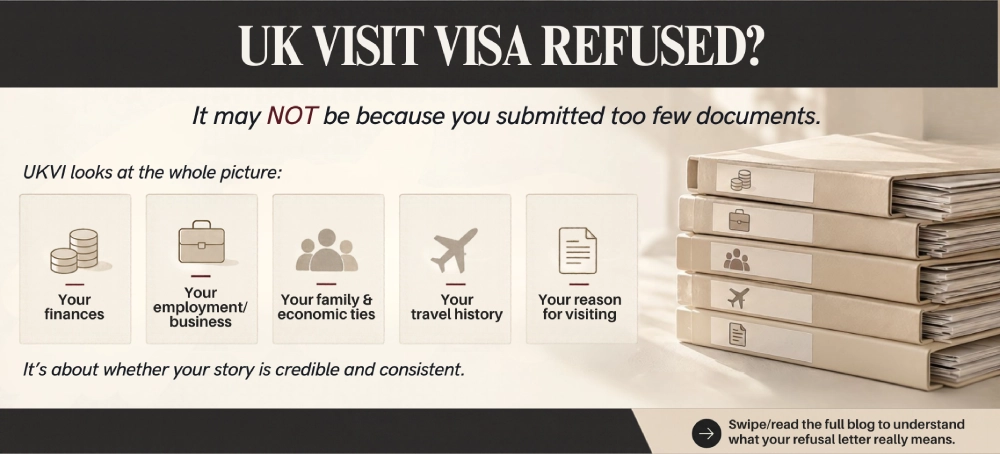
However, getting a visitor visa is about more than simply showing that you have enough money in your bank account or that someone in the UK has invited you to visit.
The Home Office looks at your application as a whole. This means considering your personal and financial circumstances, the reason for your visit, your ties to your home country and the evidence you have provided to support your application.
Therefore, a visitor visa refusal is not always about what documents are missing. In many cases, the issue is whether your application as a whole presents a credible and consistent picture of your current circumstances.
Understanding the reasons for the refusal is the first step towards deciding whether the concerns can be addressed in a future application.
Why might the Home Office not be satisfied that you are a genuine visitor?
“I am not satisfied that you are a genuine visitor who intends to leave the UK at the end of your proposed visit” is one of the most common reasons given in UK visit visa refusal letters.
Importantly, this does not necessarily mean that the Home Office thinks you have lied or that you intend to stay in the UK illegally. Instead, the decision-maker may not be satisfied, based on the evidence provided, that your visit is genuinely temporary.
When considering this, the Home Office will look at your circumstances as a whole. This can include your previous travel and immigration history, your financial situation, your employment, your family circumstances, your connections to your home country and the reasons you have given for wanting to visit the UK.
For example, imagine that you have applied to visit your son in the UK for one month. You are not currently working, a large amount of money has recently been paid into your bank account, and several of your close family members already live in the UK.
None of these circumstances automatically means that your application should be refused. However, when considered together, they may cause the Home Office to question whether you genuinely intend to return home after your visit.
This is an important point when responding to a visit visa refusal. Providing more documents does not necessarily address the Home Office’s concerns. What matters is whether the evidence, when considered as a whole, clearly supports the circumstances you have described and shows why you intend to return home at the end of your visit.
Why having enough money may still not be enough?
One of the most common misunderstandings about a UK visit visa is that having enough money in your bank account is enough to prove that you can afford your trip. It is not quite that simple.
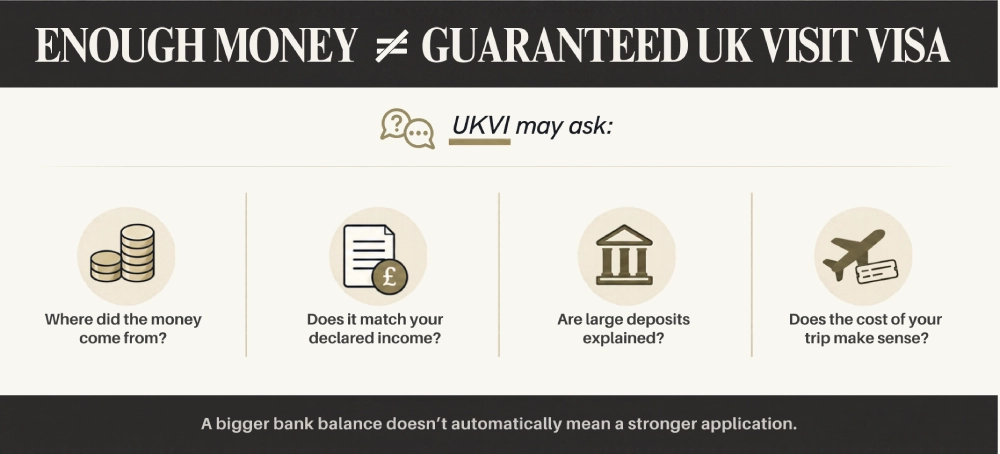
The Home Office will look at whether your financial circumstances make sense and whether the information in your application matches the evidence you have provided. This can include looking at your income, regular spending, recent transactions, large deposits and any financial support you receive from family or friends.
For example, imagine that you earn Rs. 60,000 a month and a large sum of several lakh rupees is paid into your bank account shortly before you apply for a visit visa.
The question is not simply whether you have enough money to pay for a one-month visit to the UK. The Home Office may also want to understand where the additional money came from and whether you have provided a clear and credible explanation for it.
For example:
- Is the money from your employment or another genuine source?
- If someone has given or lent you the money, who are they and why?
- Does the explanation match the information given in your application?
- Is there evidence to support the source of the money?
This is why a larger bank balance does not automatically make an application stronger. What matters is whether your financial circumstances are genuine, understandable and consistent with the information you have provided.
In other words, it is not just about how much money you have. The Home Office may also want to know where the money came from and whether the evidence supports your explanation.
Why a UK Sponsor may not be enough?
Having someone in the UK who is willing to sponsor your visit can be helpful, but it does not automatically mean that your visitor visa application will be successful.
You are able to have someone financially support you, provide accommodation or other assistance during your visit. However, you may need to provide evidence of your relationship with the sponsor, what support they will provide and that they have the financial means to provide it. Where relevant, the sponsor’s lawful status in the UK may also need to be shown.
For example, your brother in the UK may provide an invitation letter confirming that you can stay with him and that he will pay for your accommodation and living expenses. This may help explain how the costs of your visit will be covered.
However, this does not automatically show that you intend to return home at the end of your visit.
The Home Office may also look at your own circumstances, including your employment or business, family circumstances, previous travel history and other connections to your country of residence.
Could your family ties affect how your application is assessed?
You may think that having a child, parent or other close relative in the UK makes your visitor visa application stronger because it gives you a genuine reason for travelling.
It can. However, the Home Office will also consider your family and personal circumstances in your country of residence. In particular, it may look at what ties you have there and whether there are good reasons for you to return after your visit.
For example, imagine two people who are both applying to visit their children in the UK.
The first has a long-standing job, a business, close family members who depend on them and ongoing commitments in their home country.
The second is not currently working, has few immediate family responsibilities in their home country and has most of their close family members already living in the UK.
Both people may have a genuine reason for wanting to visit their children. However, their wider circumstances are very different. The Home Office may therefore have different concerns about whether each person intends to return home after their visit.
The important question is how your proposed visit fits into your wider life. Your application should explain both why you want to visit the UK and what you have to return to in your country of residence.
Can you appeal a UK Visit Visa refusal?
For most ordinary UK Visit Visa refusals, there is no right of appeal.
Limited appeal rights can arise where the decision amounts to a refusal of a human rights claim. Whether such a right exists depends on the circumstances of the individual case and the wording of the refusal decision.
Therefore, you should carefully check the refusal letter before assuming that you can appeal.
Where there is no right of appeal, you can make a fresh application.
How can ZH Law help?
ZH Law advises clients from its London and Leicester offices on UK immigration matters, including visitor visa applications and immigration refusals. If you have received a UK visitor visa refusal and are unsure what the decision means or what should be addressed before making a further application, we can help you assess the refusal and the evidence available to address the concerns raised.
Mr. Zainul Jafferji has over 27 years of experience in immigration, public law and human rights.
Frequently Asked Questions
How soon can I reapply after a UK visit visa refusal?
Do I have to mention a previous refusal in a new application?
How much money do I need in my bank account for a UK visit visa?
Can I reapply using the same documents that were refused?
Is the visa fee refunded if my application is refused?
Refused a UK visit visa, or worried about applying?
Speak to Us Today.
London: 0203 887 7306 | Leicester: 0116 365 6400 | enquiries@zh-law.co.uk