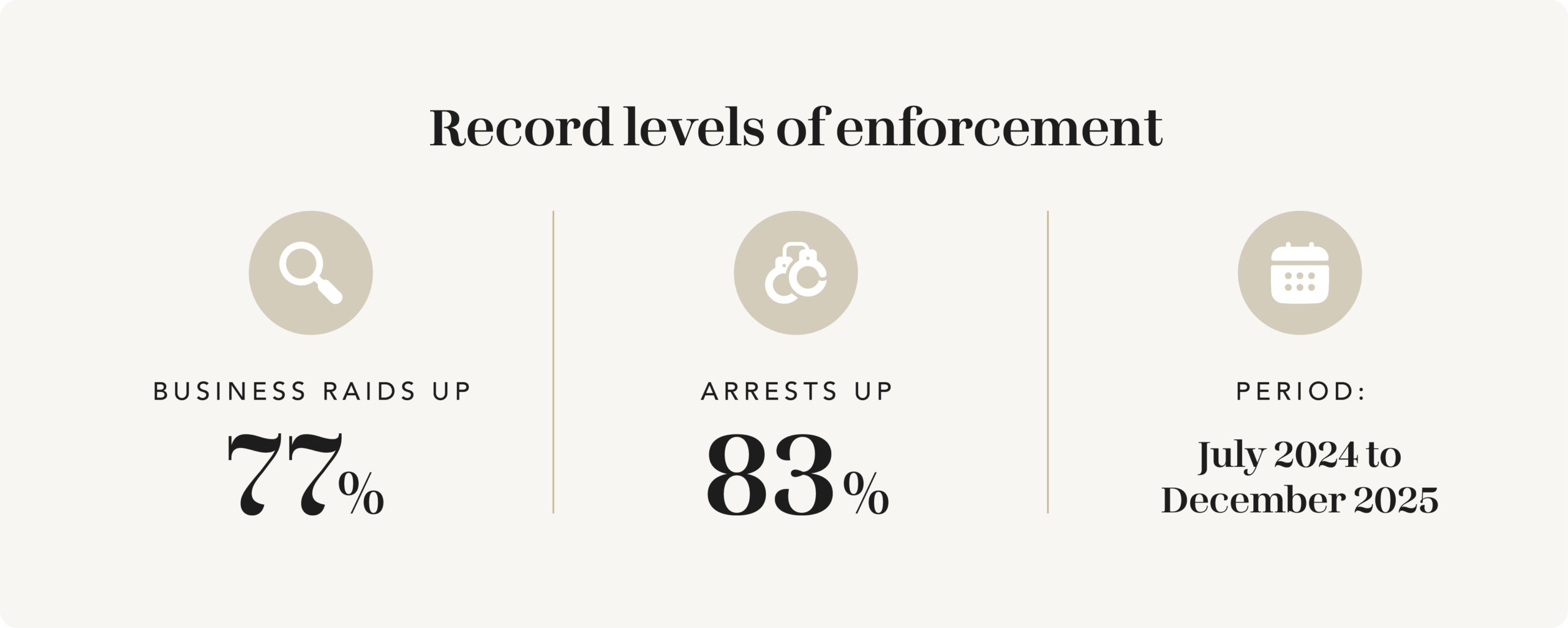
Illegal working enforcement in the UK is no longer a peripheral risk. Home Office figures show that between July 2024 and the end of December 2025, raids on businesses increased by 77% and arrests by 83%, reaching record levels. Employers operating outside the sectors that attract the most publicity may still be tempted to regard this as somebody else’s problem. Increasingly, that is an unsafe assumption.
Which industries is the Home Office actually targeting?
Home Office operations have consistently focused on sectors it describes as vulnerable to exploitation and non-compliance, including:
- nail bars and beauty salons
- car washes
- barbershops and hairdressers
- restaurants and takeaway premises
- construction sites
- warehousing, packaging and distribution
- mini-marts, convenience stores and vape shops
A single month-long operation across these sectors alone resulted in over 1,700 business visits and close to 700 arrests. London recorded the highest number of arrests of any region in 2025, with a sharp year-on-year increase.
Does that mean other industries are safe? No.
A civil penalty does not depend on deliberate wrongdoing, nor on whether an employer operates in a sector currently attracting enforcement attention. The essential question is whether the employer can establish a valid statutory excuse in respect of the worker concerned. Any business that has failed to embed the prescribed right to work check properly into its onboarding process is therefore exposed, regardless of sector.
There is also a broader reason why employers should not assume that today’s enforcement priorities will remain fixed. Right to work obligations are expanding. Reforms under the Border Security, Asylum and Immigration Act extend checking requirements beyond traditional employees to areas such as gig-economy, self-employed and platform work, arrangements which many businesses outside hospitality and retail may not previously have associated with right to work compliance.
Enforcement priorities also evolve with policy, resources and operational focus. The sectors attracting the most attention today were not always at the forefront of enforcement, and there is no reason to assume the present list is exhaustive or permanent.
What a penalty actually costs beyond the fine itself
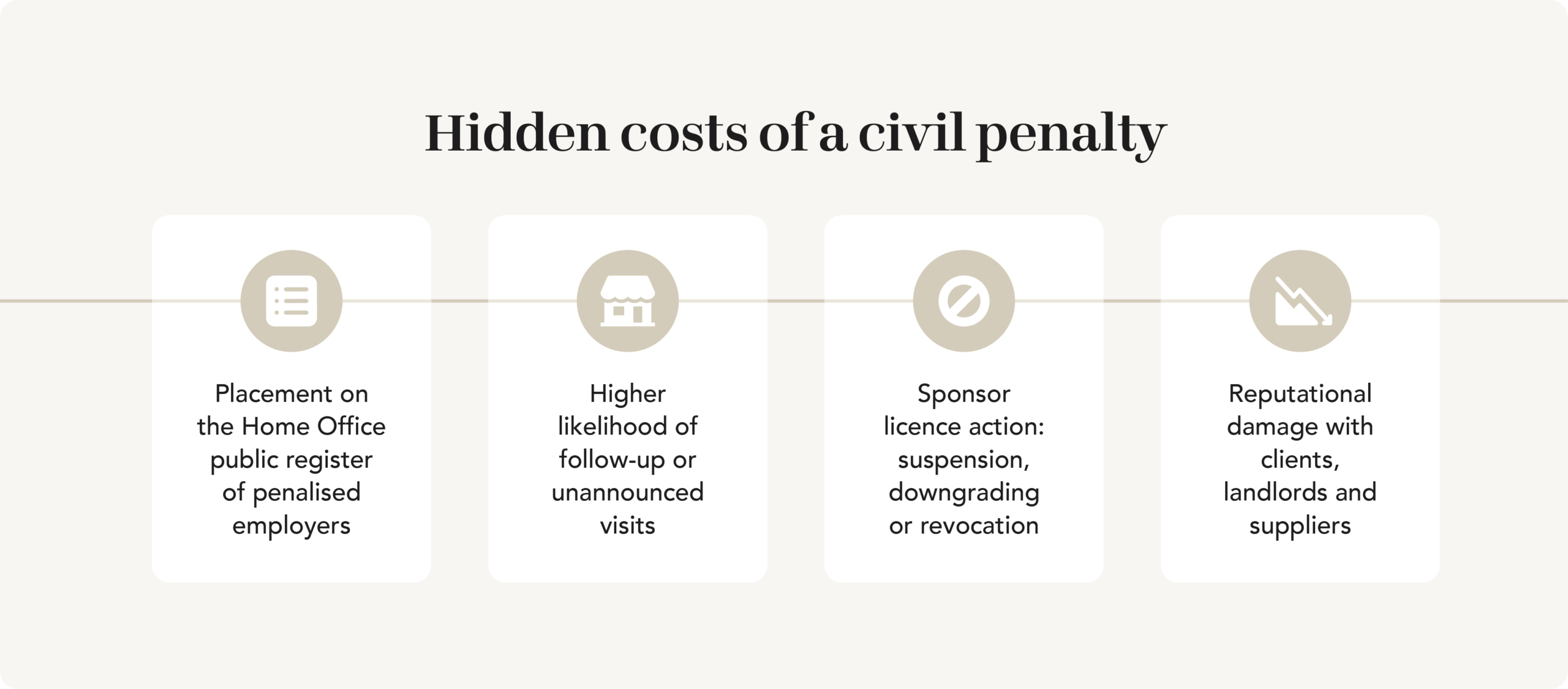
- placement on the Home Office’s public register of penalised employers
- increased likelihood of follow-up or unannounced visits
- sponsor licence action for businesses that hold one, including suspension, downgrading or revocation
- reputational damage with clients, landlords and suppliers who check that register
For sponsor licence holders in particular, the knock-on consequences to the licence itself can be more damaging to the business than the initial finding.
How to protect your business, regardless of sector
How ZH Law can help
ZH Law advises employers across all sectors on illegal working risk and civil penalty exposure. We can assist with:
- Auditing existing right to work checks and records, identifying weaknesses before they are exposed during an enforcement visit;
- Advising on agency, subcontractor and gig-worker arrangements, including where responsibility for checks may not sit neatly within standard onboarding processes;
- Preparing businesses for Home Office compliance visits, including reviewing records, systems and internal procedures in advance;
- Advising sponsor licence holders on the wider regulatory and sponsorship consequences of compliance concerns; and
- Challenging civil penalties where a penalty has already been issued.
Frequently Asked Questions
Which industries are most exposed to illegal working enforcement in the UK?
If my business is not in one of these sectors, do I still need to be concerned?
Are gig economy and self-employed workers now covered by right to work checks?
Do I need to carry out right to work checks for British and Irish citizens?
What is the most common compliance weakness across higher-risk sectors?
Unsure whether your industry, or your business specifically, is exposed?
Speak to ZH Law today.
London: 0203 887 7306 | Leicester: 0116 365 6400 | enquiries@zh-law.co.uk